ResponseOne
Navigation for ambulance crews

Get your crew to the door. Not just the block.

Routes that skip rush-hour turn bans. The exact house, on the right side of the street. A live map of every unit for your dispatchers.
Live in NYC, Long Island, Westchester & NJAndroid · iPhone · WebFree 30-day pilot
responseone.app · Dispatch
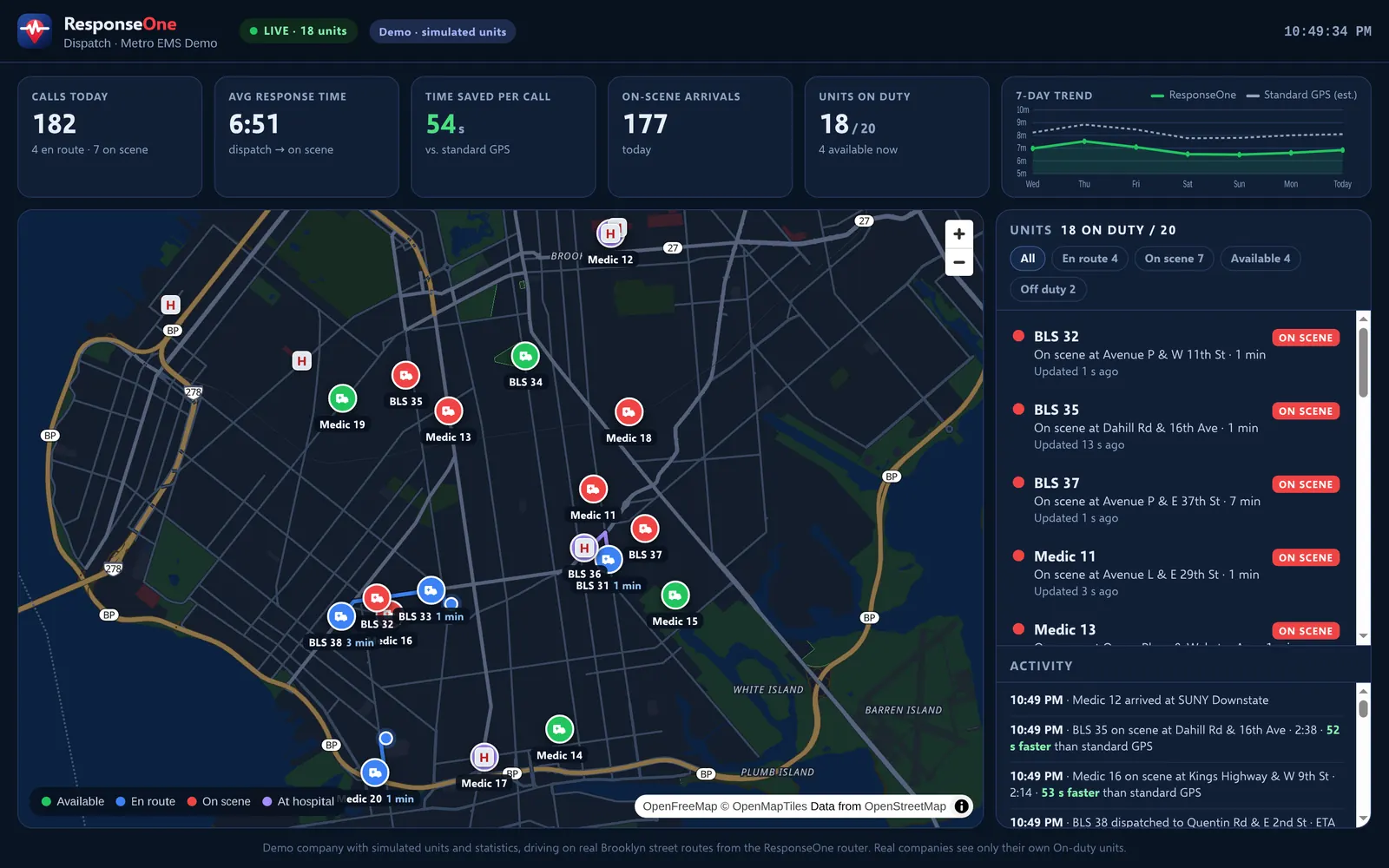
ResponseOne dispatcher map with every on-duty unit, its status and ETA
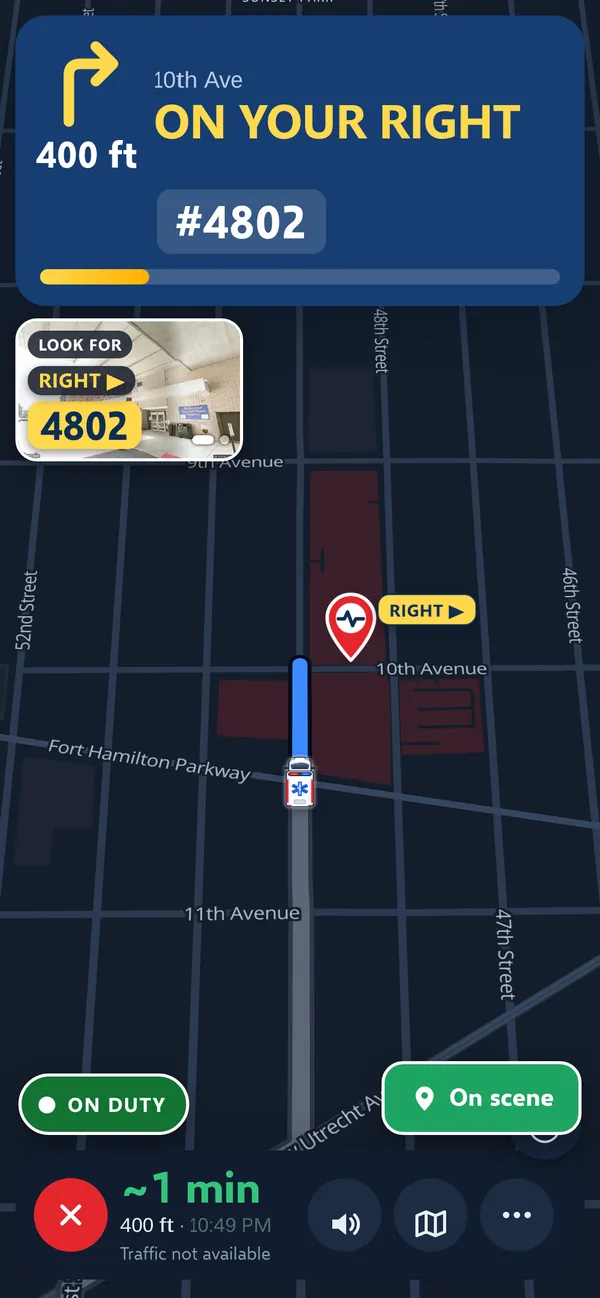
ResponseOne arrival screen: distance in feet, side of the street and the house number
Built from real callsEvery rule comes from a working Brooklyn EMS responder.
39 routing and screen rulesAnd counting. Each one fixes a delay seen on a real call.
No hardwareRuns on the phone or tablet already in the rig.
Dispatchers ride freePay per ambulance. Dispatch and admin seats cost nothing.
The problem

The clock keeps running after the ambulance reaches the block.

13:09

Average time from a 911 call to arrival at life-threatening medical emergencies in NYC (FY2026). Up 3 min 50 s since FY2015.

NYC Comptroller, Oct 16, 2026
28%

Of real response time is spent between pulling up and reaching the patient. A median of 2.1 minutes.

Silverman et al., Acad Emerg Med 2007 (449 NYC calls)
−11%

Lower odds of good neurological survival from cardiac arrest for every extra minute of EMS response.

Goto et al., J Am Heart Assoc 2018 (553,426 patients)

Where the seconds go: the wrong side of the street and a loop around the block. A no-left-turn sign a civilian app obeys. A long one-way, stuck behind a double-parked truck. A new EMT who has never driven the neighborhood.

Why consumer GPS falls short

Consumer GPS routes an ambulance like a civilian.

ResponseOne routes it like a medic who knows the streets.

Situation
Consumer GPS
ResponseOne
Turn bans
Obeys rush-hour bans like “no left 7–10 AM”.
Responder mode skips congestion turn bans.
One-way streets
Sends a rig down a long one-lane one-way.
Avoids one-lane one-ways of 1,800 ft or more. Short ones only when faster.
Arrival
“Destination on the right,” somewhere on the block.
Feet countdown, left or right, the house number you’re passing, and a photo of the building.
Corner buildings
Ends on the entrance street.
Picks the fastest end point: front street, corner or cross street.
Hospitals
A generic search result.
Closest hospitals by drive time, filtered by specialty.
Dispatch
Nothing. The crew calls in.
A live map of every on-duty unit, and a one-tap “I’m on scene”.
Responder routing

Routes that think like a Brooklyn medic.

The crew picks Responder or Regular for each trip. Responder mode applies rules learned on real calls before the rig moves.

  • Skips congestion turn bans. “No left 7–10 AM” doesn’t stop an ambulance. Other restrictions stay.
  • Avoids long one-lane one-ways. Stretches of 1,800 ft or more are avoided. You can get stuck behind one car.
  • Prefers two-way avenues. One lane each way beats two lanes one way. There’s room to get around.
  • Few turns, especially lefts. Turns cost time. The route reflects it.
  • Always offers a streets route next to any highway route, with the time difference.
Responder mode skips a rush-hour turn ban An ambulance on Kings Highway needs to turn left onto Ocean Avenue. A no-left-turn sign applies 7 to 10 AM. Consumer GPS loops around the block. ResponseOne's responder mode turns left directly. KINGS HWYOCEAN AVE 7–10 AM
ResponseOne responder routeConsumer GPS
The last 500 feet

The exact house. Not “somewhere on the right.”

On the final block, ResponseOne switches to arrival mode. The crew knows where to stop before they get there.
  • Distance in feet. 600, 400, 200, 100, 50.
  • Left or right, checked twice. Shown only when the route and NYC address points agree. A wrong side is worse than none.
  • The house number you’re passing next to the one you need.
  • A photo of the building, so the crew knows what to look for.
  • Corner buildings: ends at the corner or on the cross street when that’s faster.
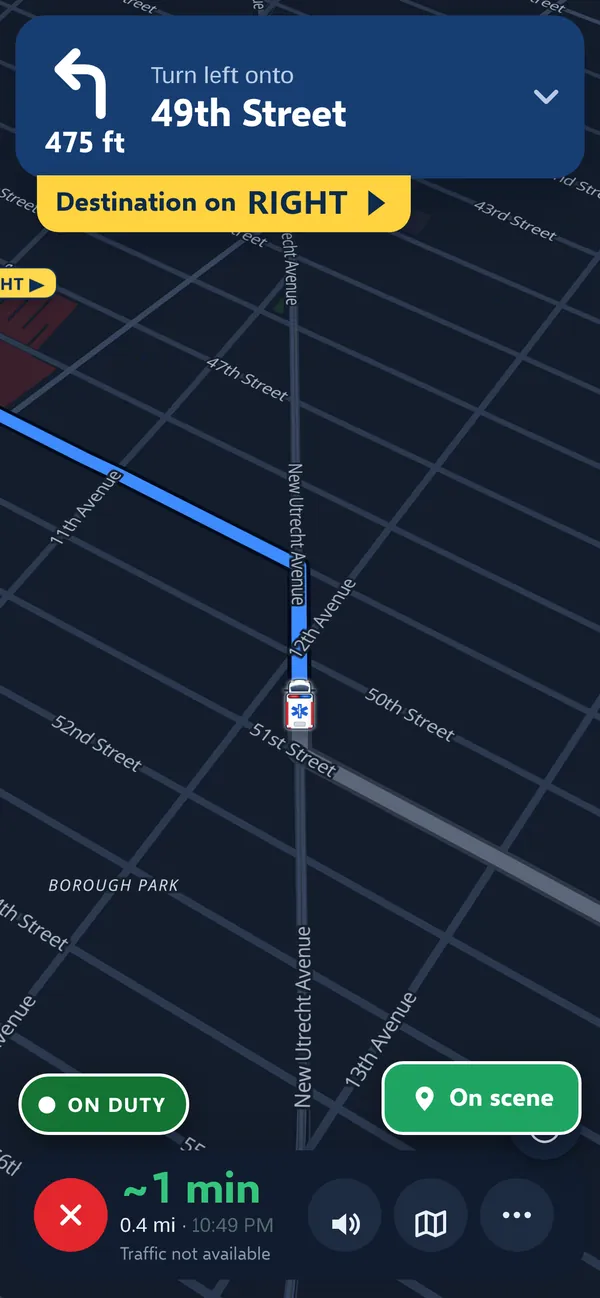
Turn-by-turn guidance with the next intersection
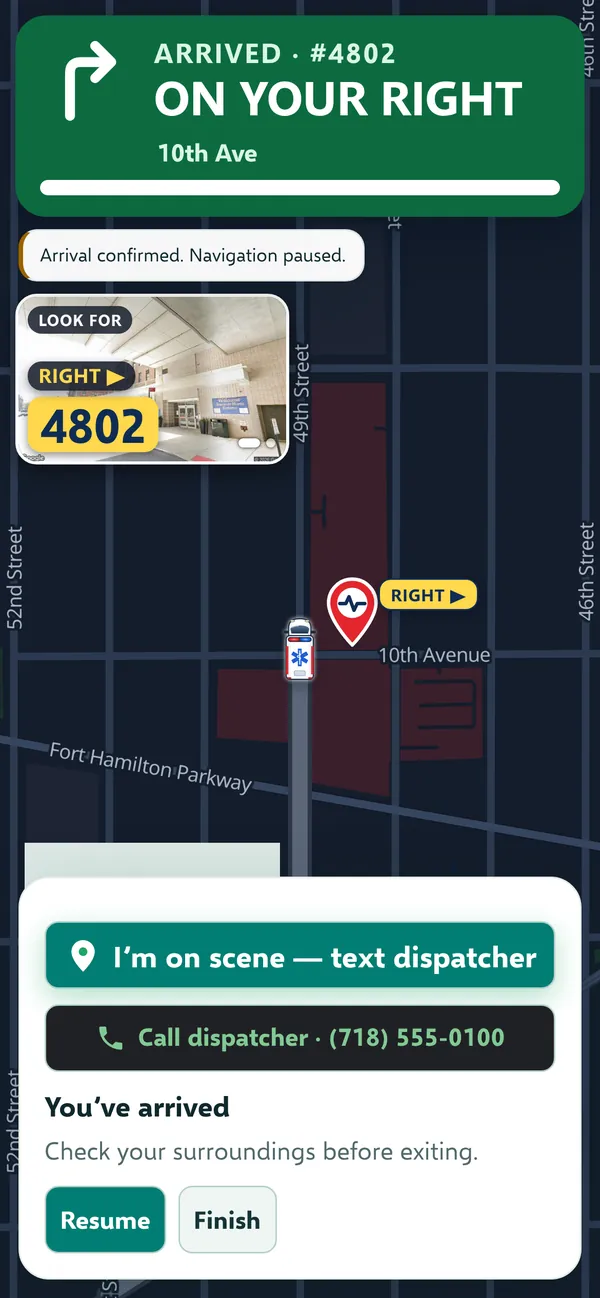
Arrived screen with the house photo and an I am on scene button
For the company

Every unit on one live map. Only your units.

Each company gets its own dispatch view. Status, ETA and last update for every on-duty unit, refreshed every 5 seconds.
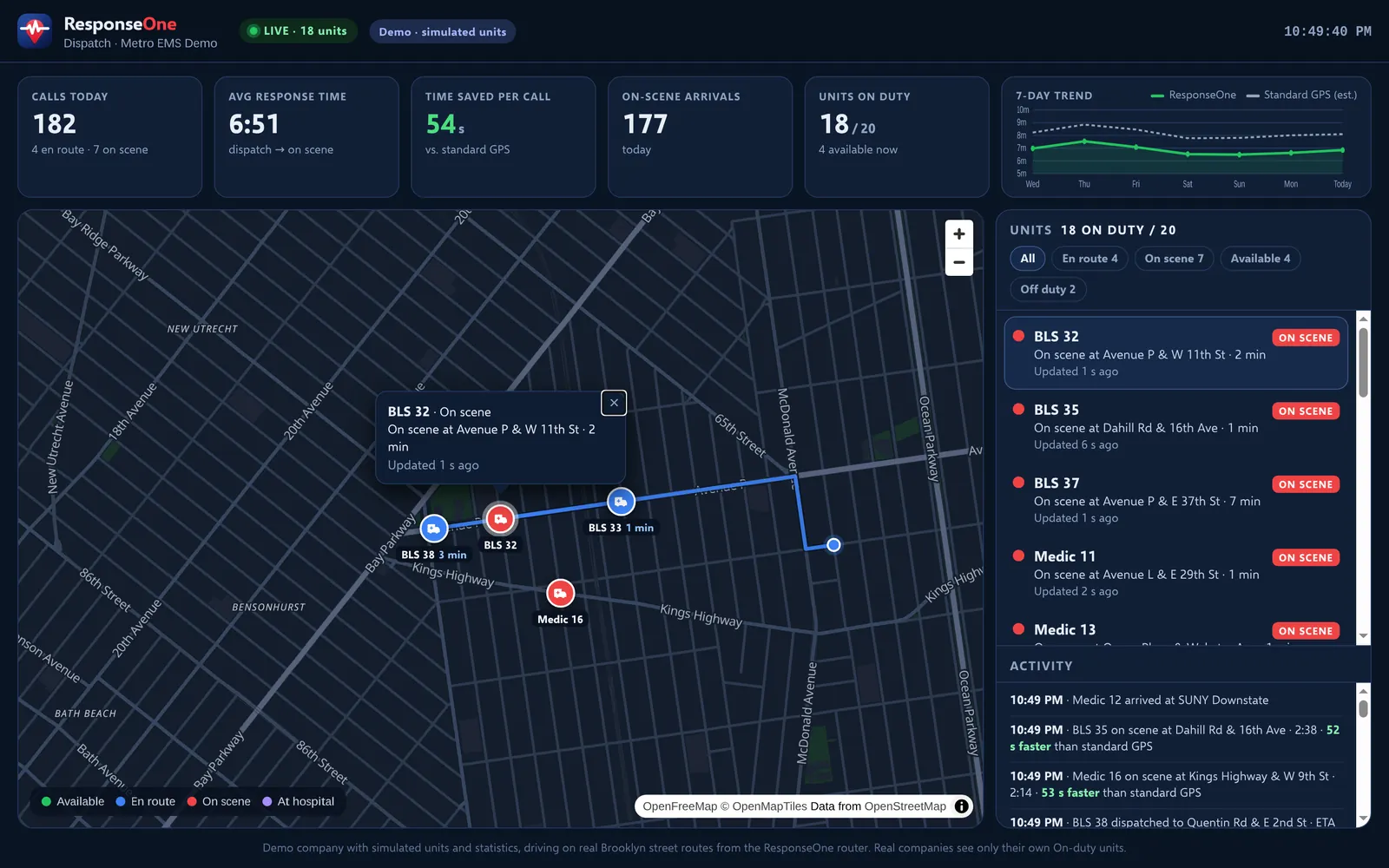
  • Isolated by company. Enforced on the server. A dispatcher never sees another company’s rigs.
  • On duty / off duty. A unit shares its position only while on duty. Off duty, dispatch sees nothing.
  • One tap: “I’m on scene.” Texts the dispatcher from the crew’s own phone.
  • Your admin hands out the keys. Each code locks to one phone. Revoke it in a second.

Open the live dispatch demo

Dispatch view with a selected unit showing destination, ETA and last update
Dispatch / CAD API

Your CAD sends the call. The crew taps once.

A documented REST API for any dispatch system with an open API. The call pops up on the unit’s phone. One tap starts the route.

  • Send a call to a unit with an address or coordinates, priority and notes.
  • Status comes back by itself. En route, on scene, transporting, available. Signed webhooks.
  • Per-company API keys. Created and revoked by your admin. Stored hashed.
  • Idempotency keys and rate limits built in.

Read the API docs

Everything else a crew needs

Built for the call, not the commute.

Dispatch / CAD API

Your CAD sends a call straight to a unit’s phone. One tap starts the route. Status flows back automatically.

Live

Shared closures

One crew blocks a street. Every unit in the company routes around it within a minute. Blocks expire after 4 hours.

Live

Closest hospitals

Ranked by drive time from the unit. Filter by trauma, thrombectomy stroke, cardiac, burn, pediatric, L&D or psych.

Voice that names the corners

Spoken turn-by-turn with intersection callouts. Tap the banner for the next steps.

Open from any message

Tap an address in a text or WhatsApp. ResponseOne opens straight into the route.

Licenses you control

One license per ambulance. Codes lock to one phone. Suspend a company and it’s locked out within a minute.

Works in dead zones

No signal? The active route and map stay on the phone. The crew sees “Offline — using saved route” and keeps driving.

Live

Keeps guiding in the background

Switch to the phone or the patient app. A mini map keeps the route going, with voice.

NYC, Long Island, Westchester, NJ

Routing covers the whole metro area. Side-of-street checks use NYC address data, so they’re sharpest in the five boroughs.

Live
How it works

Live in a day. No hardware.

01 — DAY 0

We set up your company

Your company, unit codes and dispatcher login. Your admin manages codes from then on.

02 — MINUTES

Crews install and sign in

Android, iPhone or web. Each code locks to the phone in the rig. Go on duty and drive.

03 — EVERY CALL

Dispatch sees it live

Every on-duty unit on one map. Calls from your CAD go straight to the unit.

ROI · base case estimate

150 ambulances × 36 seconds a call.

$819ka year, estimated
Responses a year · 150 ambulances × 6 a day328,500
Crew-hours freed · 60% to a street address × 60 s saved3,285
Added transport revenue · half the freed time filled$754k
Late-response penalties avoided$66k
ResponseOne licenses · 150 × $39 × 12$70k

The assumption that matters

60 seconds saved on 60% of calls, and half of the freed time filled with paid trips. An estimate based on these assumptions; a 30-day evaluation measures it for your fleet.

ScenarioConservativeBaseAggressive
Seconds saved / call306090
Annual value$190k$819k$2.08M
Value ÷ license cost2.7×11.7×29.6×
Payback incl. setup4.8 mo1.1 mo0.4 mo

All figures are estimates from our ROI model, not results. Inputs: 150 ambulances, 6 responses a day, $1,147 collected per transport (CMS GADCS / RAND, via PWW Advisory Group 2025), 0.40 trips per unit-hour (Fitch 2015), $39 per ambulance per month plus $5,000 setup. The full model is available on request.

Pricing

Priced per ambulance. Prove it free first.

Enterprise · 100–249 ambulances
$39per ambulance / month

Billed yearly. One license = one rig’s phone, whoever is on shift.

  • Unlimited dispatcher and admin logins
  • Your admin creates and revokes its own codes
  • Live dispatch map, Dispatch API, shared closures
  • Crew training and dispatcher onboarding
See all plans
Pilot
Free

30 days · 10 ambulances · one base.

  • We set up your company and codes on day 0
  • Every trip logged: route, on-scene time, crew rating
  • Week 4 readout against the same units last month
  • You keep the numbers either way
Start a pilot
FAQ

Straight answers.

Something else? [email protected]

Does it replace our CAD?

No. It works next to it. Your CAD can send calls straight to a unit through the Dispatch API, and unit status goes back to your CAD.

Does it tell crews to break traffic laws?

No. Responder mode only skips congestion turn bans, like “no left turn 7–10 AM”. It never routes the wrong way down a one-way. It gives guidance; crews follow their agency’s emergency vehicle policy and the law.

Do you track crews when they’re off duty?

No. A unit shares its position only while it is on duty, and only with its own company.

What phones does it run on?

Android, iPhone and any modern browser. No extra hardware.

Where does it work?

New York City, Long Island, Westchester and New Jersey. It was built and tuned on Brooklyn calls. Side-of-street checks use NYC address data, so they’re sharpest in the five boroughs. Elsewhere? Ask us.

How is it priced?

Per ambulance, per month, billed yearly: $49 for 25–49 ambulances, $44 for 50–99, $39 for 100–249, $34 for 250+. Dispatchers and admins are free.

What does the pilot cost?

Nothing. 30 days, 10 ambulances, one base. We agree on the success measures before it starts.

How fast can we start?

Setup takes a day. Crews install and sign in within minutes.

Book a demo

Run it on 10 of your ambulances. Free for 30 days.

20 minutes on a call. We show you the crew app and your dispatch map, then set up a pilot.